EN


Why AI Bias Is a Business Risk -Not Just an Ethics Issue
04-06-2026
Bias as a commercial, reputational, and operational risk
Most discussions frame AI bias as a fairness or compliance issue. However, biased AI can also affect decision quality, customer trust, organizational performance, and market alignment. In other words, AI bias creates business risks that extend far beyond ethics.
|
Risk Area |
Example Impact |
|
Strategic Risk |
Distorted decision-making at scale |
|
Operational Risk |
Workforce inequality and talent loss |
|
Reputational Risk |
Customer mistrust and market misalignment |
Recent cases involving Meta, Workday, Rite Aid, and Google demonstrate that AI bias is no longer merely an ethical concern. It can trigger product redesigns, legal scrutiny, operational disruption, and reputational damage.
|
Company |
Year |
Type of impact |
Short impact metric |
Source link |
|
Meta (Facebook housing ads) |
2022 |
Legal/regulatory + operational |
DOJ settlement; discriminatory ad tool terminated; new delivery system; independent reviewer; $115,054 civil penalty |
|
|
Rite Aid |
2023 |
Operational + reputational + regulatory |
5-year facial-recognition ban; FTC alleged thousands of false matches |
|
|
Workday |
2024 |
Legal + reputational |
First-of-its-kind AI hiring bias case survived dismissal; proposed class could include hundreds of thousands |
|
|
Google (Gemini) |
2024 |
Operational + reputational |
Paused people-image generation shortly after launch following bias/backlash |
|
|
Meta (Facebook job ads, France) |
2025 |
Regulatory + reputational |
French watchdog found indirect sex discrimination; 3-month corrective recommendation |
|
|
X (Twitter photocropping) |
2021 |
Operational + reputational |
Removed auto-cropping for single images after internal study found race/gender disparities |
Short Lessons out of the cases:
- Bias often emerges as an operational issue before it becomes a compliance issue.
- Accountability cannot be fully outsourced to vendors.
- Access-related AI systems carry the highest risk.
- Most failures stem from recurring governance gaps.
Hidden Realities Behind AI Bias
Above mentioned AI bias incidents occured in some of the world's most innovative technology companies. Why do even highly sophisticated organizations fall into the trap?
1- The myth of “neutral technology”
AI systems are shaped by:
- training data
- human assumptions
- cultural norms
- business priorities
Technology does not exist outside human context. AI systems learn from human-created environments and inevitably reflect the assumptions embedded within them.
Bias typically emerges through three interconnected sources:
1_ Systemic Bias (related to ‘data’)
Embedded in institutions, organizational processes, historical patterns, and social structures.
2_ Computational Bias (related to ‘algorithms’)
Emerges from data quality issues, sampling limitations, and algorithmic design choices.
3_ Human-Cognitive Bias (related to ‘implementation’)
Introduced through human assumptions, interpretations, and decisions throughout the AI lifecycle.
What often appears to be "neutral technology",
is simply one worldview presented as universal.
2- Bias Is Often ‘Invisible Until It Scales’
The most dangerous biases are not always the most visible ones. Bias seeps into the decisions our systems make, and without judgment may people accept as “objective.” [1]
Research increasingly shows that AI does not automatically remove human bias. In many situations, people overtrust AI recommendations and reinforce existing patterns rather than challenge them, which ends up with creating a feedback loop that becomes increasingly difficult to detect. Over time, this may become an organizational challenge: people stop questioning, stop appealing, and gradually adapt to systems they no longer fully trust. The result:
AI does not only automate decisions.
It can automate blind spots at scale.
What Can Organizations Do? [2]
AI systems are dynamic, complex, and constantly evolving. Risks may not be visible during development and often emerge only after deployment. This becomes even more challenging when organizations rely on third-party models and external data sources.
At the same time, AI adoption is accelerating faster than previous generations of technology. The challenge is no longer access to AI; it is the quality of how AI is used.
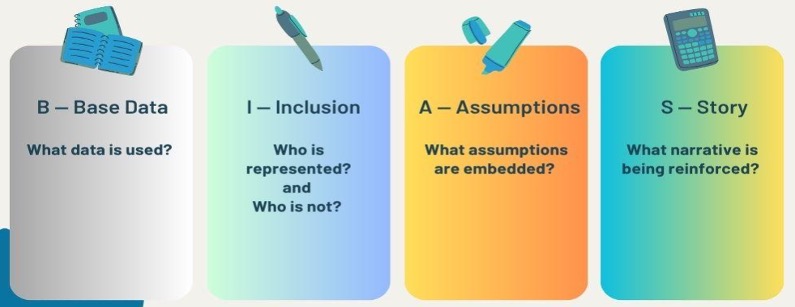
To navigate these risks, we need practical ways to assess bias before it scales.
The BIAS Lens is a simple framework to remember for asking better questions:
Five Practical Actions
1- Build Bias Awareness
Understand that AI outputs are shaped by data, assumptions, and context—not just algorithms.
2- Maintain Meaningful Human Oversight
Ensure that people can challenge, review, and appeal AI-driven decisions.
3- Audit systems within their specific context and Monitor Continuously
Use fairness metrics, independent audits, and ongoing monitoring to identify bias before it scales.
4_ Increase Transparency and Explainability
Help employees, customers, and stakeholders understand how important decisions are made.
5_ Establish Strong AI Governance
Integrate bias management into leadership, risk management, and organizational governance processes.
AI bias is not only an ethical issue.
It is a leadership, governance, and organizational challenge.
Conclusion
- Bias is not a technical bug; it is a business risk.
- Algorithms learn organizational history -including its inequalities.
- Trust can be lost faster than compliance can be restored.
AI does not simply learn from data. It learns from organizations, histories, assumptions, and cultures. The question is not whether bias exists. The question is whether we can recognize it before it scales.
If you are interested in what you can do to mitigate AI Bias in your journey, we would be happy to connect together with our partner company Culturevate Consulting. Please feel free to contact us directly.
Further Reading
NIST AI Risk Management Framework (2023) NIST AI RMF
The NIST framework treats AI risk not only as a technical issue but also as an organizational and societal challenge. AI risk management is a lifecycle activity, not a one-time audit. It emphasizes continuous monitoring, governance, stakeholder engagement, and human oversight.
The OECD AI Principles are among the most widely adopted global governance frameworks for trustworthy AI. They emphasize fairness, transparency, accountability, and human-centered values.
[1] https://nvlpubs.nist.gov/NISTpubs/SpecialPublications/NIST.SP.1270.pdf
[2] https://nvlpubs.nist.gov/nistpubs/ai/NIST.AI.100-1.pdf
If You Want To Share